
Master the Triangle Method eye contact technique backed by neuroscience. Learn the psychology behind instant attraction, common mistakes & real-life applications.
INTRODUCTION
This technique complements broader psychology mind hacks that help you build genuine connections and understand social dynamics better.
Ever wondered how to make someone fall for you without saying a single word?
In 2024, neuroscience discovered something extraordinary: a precise eye contact pattern can synchronize two brains in just 3 seconds—literally creating a neural bond before any conversation even begins.
This isn’t manipulation. It’s not a psychological “hack.” It’s evolutionary biology weaponized through something called the Triangle Method.
This viral TikTok technique, dominating dating conversations among Gen Z and Millennials, is more than just another dating trend. It’s backed by peer-reviewed research from Arthur Aron’s famous 36 Questions Study, fMRI brain imaging, and decades of behavioral psychology.
What is the Triangle Method? It’s a precise visual technique where you trace an invisible triangle across someone’s face—left eye → lips → right eye—creating an “intimacy loop” that triggers oxytocin release, mirror neuron activation, and unconscious desire.
The result? People report feeling an instant, magnetic connection they can’t explain.
In this comprehensive guide, you’ll discover:
- The exact neuroscience behind why it works
- Step-by-step execution (timing, technique, calibration)
- Common mistakes that make you look creepy
- Real-world applications for dating, relationships & beyond
- Scientific studies that prove its effectiveness
- Ethical considerations and when NOT to use it
Let’s dive in.
WHAT IS THE TRIANGLE METHOD? | REVEALING THE INTIMACY LOOP OF ATTRACTION
The Geometry of Desire
The Triangle Method is a deliberately engineered eye contact pattern—not a stare, but a dynamic gaze flow that mimics how lovers naturally view each other.
Here’s what makes it different from regular eye contact:
Traditional Eye Contact: Lock and hold. Creates tension. Can feel aggressive.
Triangle Method: Move and flow. Creates intimacy. Feels magnetic.
The technique is simple in concept but powerful in execution:
The Triangle Pattern (The “Intimacy Loop”):
- Left Eye (1-1.5 seconds) → Establish warmth and openness
- Lips (1 second) → Signal intimate interest and desire
- Right Eye (1-1.5 seconds) → Confirm connection and reassurance
- Repeat naturally as conversation flows
Total cycle: approximately 3 seconds | Frequency: Use sparingly (2-3 times per meaningful conversation moment).
Why It’s Called the “Intimacy Loop”
Each transition awakens deeper emotional and chemical connections. You’re not staring blankly—you’re exploring their face the way a lover would. Your gaze becomes a form of non-verbal communication that says: “I am deeply interested in you.”
This is different from the “Lovers’ Gaze” studied in attachment theory. The Triangle Method is the accelerated version—it simulates months of bonding in seconds.
Step-by-Step: How to Perfectly Do The Triangle Method
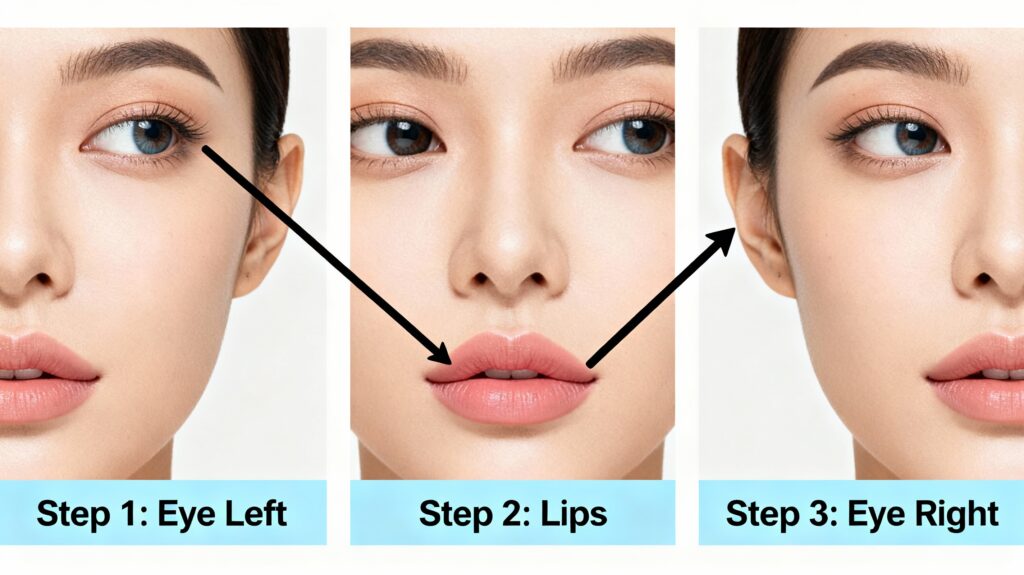
Step 3 right eye with timing instructions for eye contact technique
The Complete Execution Guide (Timing, Technique, Pro Tips)
This is where theory becomes practice. Follow this exact sequence for maximum effectiveness.
Phase 1: LEFT EYE – THE CONNECTION (1-1.5 seconds)
What you’re doing:
- Lock onto their left eye (from your perspective, their right eye)
- Hold a soft, warm gaze—not intense, not weak
What’s happening in their brain:
- Mirror neurons activating
- Initial oxytocin release beginning
- Amygdala checking: “Is this safe or threat?”
Your facial expression MATTERS:
- Soft smile (Duchenne smile—reaches the eyes)
- Relaxed eyebrows
- Warm, open energy
- Dead expression (looks predatory)
- Tense jaw (looks aggressive)
If you have social anxiety, this first phase is your “grounding moment.” Take a breath. Remind yourself: “I’m genuinely interested in this person.”
Phase 2: LIPS – THE DESIRE (1 second)
What you’re doing:
- Smoothly drop your gaze from their left eye down to their lips
- Don’t stare—a brief 1-second “brush” is sufficient
- This isn’t obvious; it should look natural, like you’re listening intently
What’s happening in their brain:
- Dopamine spike (anticipation of kiss)
- Lips become hyper-sensitive
- They may unconsciously lick their lips or touch their mouth
- Body goes into “arousal mode”
Psychological interpretation:
Their brain receives the signal: “This person wants to kiss me.” Even if they’re not consciously aware of it, their nervous system knows.
Pro Tip: If you’re nervous about the lip gaze looking obvious, remember—people naturally look at lips when they’re deeply engaged in conversation. It’s called “active listening.” You’re just doing it intentionally.
Critical Warning:
If they look uncomfortable or pull away, STOP immediately. Move to normal eye contact. The technique is only effective when the other person is open to connection.
Phase 3: RIGHT EYE – THE CONFIRMATION (1-1.5 seconds)
What you’re doing:
- Sweep your gaze upward to their right eye
- Hold briefly, with that same warm smile
- This completes the triangle and signals reassurance
What’s happening in their brain:
- Integration of all signals (love + desire + safety)
- Mirror neuron resonance deepening
- Emotional synchronization occurring
- They feel seen and desired simultaneously
Facial expression:
- Genuine smile (you’re pleased by this connection)
- Soft eye contact (not aggressive)
- Relaxed shoulders (shows confidence)
This “return to the eyes” phase is crucial. It reassures the other person that you’re not just interested in their body—you see their whole self.
TIMING MATTERS: THE 3-SECOND RULE
Full Triangle Cycle: approximately 3 seconds total
- Left eye: 1-1.5 seconds
- Lips: 1 second (brief)
- Right eye: 1-1.5 seconds
Research Insight (London Science Museum Study):
Nearly 500 participants rated eye contact comfort levels. The sweet spot? 3.2-3.3 seconds.
- Under 2 seconds: Feels rushed, mechanical, insincere
- 3-4 seconds: Feels natural, intimate, magnetic
- Over 5 seconds: Starts feeling uncomfortable, aggressive, creepy
The frequency rule: Use only 2-3 times per conversation. Overdoing it looks robotic and manipulative.
Common Mistakes That Ruin the Magic
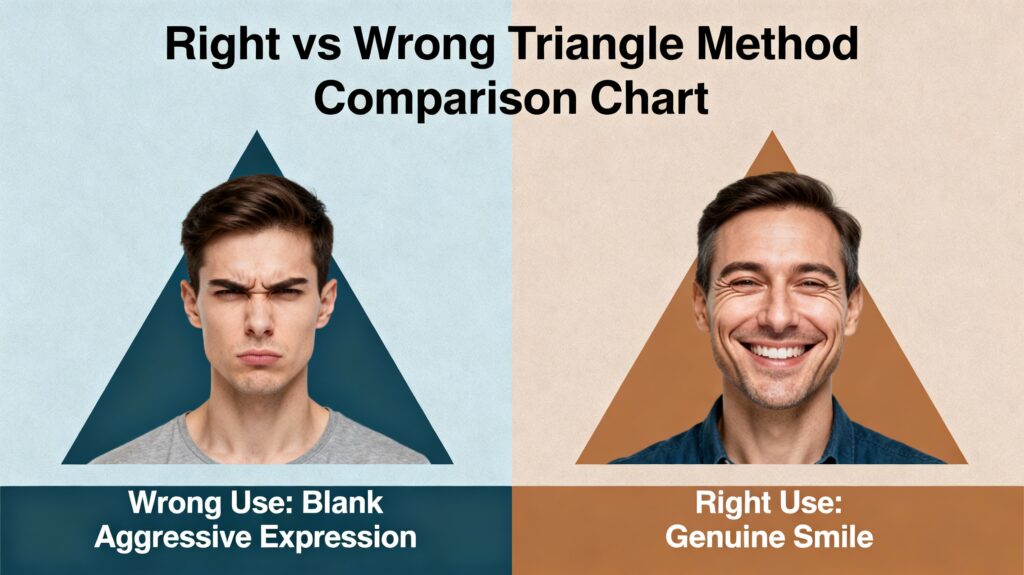
Mistake 1: Staring Too Long
Why it fails: Triggers the amygdala’s threat detection. Recipient feels uncomfortable.
The fix: Quick transitions (1-1.5 sec per focal point), soft smile, natural blinks
Mistake 2: Dead Expression (No Smile)
Why it fails: Creates “uncanny valley” or “serial killer” vibes. Looks predatory.
The fix: Genuine smile that reaches your eyes (Duchenne smile). Your smile is 70% of the technique’s power.
Mistake 3: Rushing or Robotic Execution
Why it fails: Obvious, feels manipulative, recipient detects the calculation.
The fix: Smooth, natural flow. Synchronized with conversation. Blend it naturally—don’t make it your only tool.
Mistake 4: Wrong Context
Why it fails: Using it on strangers in professional settings or people who haven’t signaled interest.
The fix: Reserve for romantic/flirty situations with mutual openness. In business, use the “professional triangle” (eyes + forehead) instead.
Mistake 5: Ignoring Body Language Cues
Why it fails: Continuing despite discomfort signals = harassment.
The fix: Watch for: crossed arms, leaning back, looking away, furrowed brows. If you see these, STOP immediately.
Mistake 6: Using Without a Smile
Why it fails: Even perfect technique looks creepy without warmth.
The fix: Smile is non-negotiable. It transforms the entire signal from “predatory” to “attractive.”
Pro Tip: Understanding body language signals helps you read discomfort cues and adjust your approach in real-time.
Before vs. After: Why The Triangle Method Wins
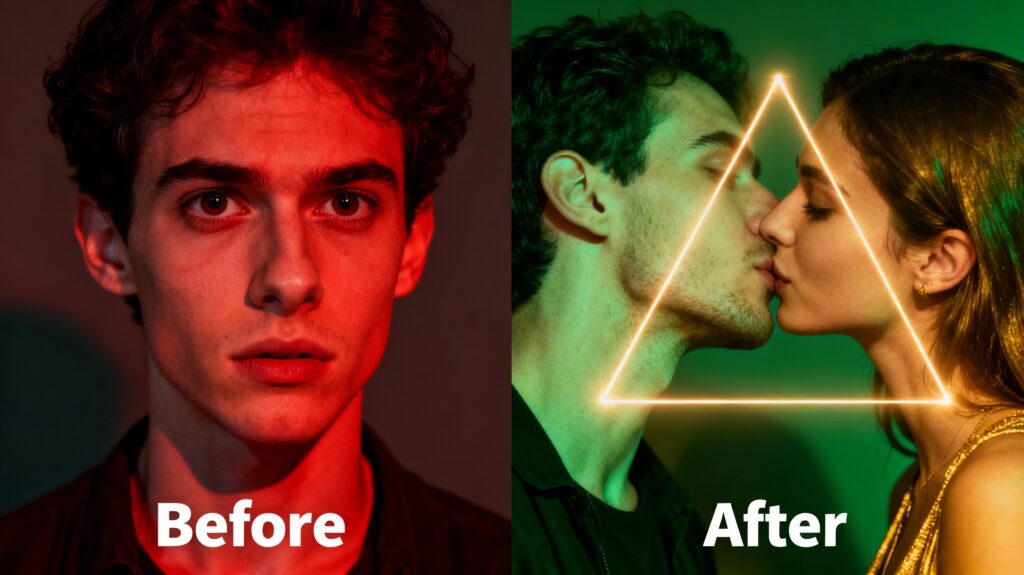
The Visual Comparison
LEFT (WRONG): Awkward, frozen eye contact
- Person looks uncomfortable
- Energy drops
- Connection doesn’t deepen
- Recipient feels stared at, not engaged
RIGHT (CORRECT): Engaged, dynamic triangle gaze
- Person leans in
- Attraction visible
- Connection deepens
- Recipient feels seen and desired
Does The Triangle Method Work on Everyone?
Context Matters. Here’s When It Works Best:
Best for: Romantic & Flirty Situations
The effect is strongest when mutual interest already exists. If there’s chemistry, the Triangle Method accelerates it exponentially. If there’s no interest, the technique won’t create attraction from zero—but it can build on existing signals.
Gender & Context
Works on: Both men and women equally
Important caveat: Cultural norms and individual personalities matter
- In Western cultures (US, UK, Australia, etc.), direct eye contact signals confidence and interest
- In Eastern cultures (parts of Asia, Middle East), prolonged eye contact can be perceived as disrespectful or aggressive
- Individual factors: Neurodivergence, trauma history, attachment style, and personality all influence reception
Strangers vs. Partners
With strangers: Use sparingly and watch for reciprocal interest. One Triangle Method might be enough to gauge response.
With partners: Can reignite lost chemistry by recreating the intentional attention from early dating. Long-term couples report it’s like “falling in love again.”
For Neurodivergent Users (ADHD, Autism, Social Anxiety)
The Triangle Method provides structure that helps many neurodivergent individuals:
- ADHD: Replaces anxiety about “where to look” with an algorithmic pattern
- Autism: Distributes eye contact to reduce autistic stare or gaze avoidance
- Social Anxiety: Gives a “script” for eye contact, reducing cognitive load
Adaptation: If direct eye contact triggers sensory overload, use the “Inverted Triangle” (eyes + forehead) for a softer version.
The Science: Studies That Prove It Works
Learn More About the Science:
For deeper understanding of mirror neurons and their role in social bonding, explore research on mirror neurons by Dr. Giacomo Rizzolatti, who pioneered this field of neuroscience.
To understand oxytocin’s role in attraction and bonding, read more on Psychology Today’s comprehensive guide to attachment and bonding.
Arthur Aron’s original 1997 study can be found in the APA PsycNET database, which contains peer-reviewed psychological research.
Study 1: Arthur Aron’s 36 Questions (1997)
What he did: Paired strangers and had them ask progressively intimate questions, ending with 4 minutes of uninterrupted mutual gaze.
Result: Strangers reported significant attraction increases. One couple from the study later married.
Relevance: Proves mutual eye gaze can create attachment bonds rapidly. The Triangle Method is the accelerated version.
Study 2: University of Chicago (2020s)
What they found: Eye gaze = romantic love signal. Lip gaze = sexual desire signal.
Relevance: The Triangle Method deliberately combines both signals, creating a hybrid attraction response.
Study 3: Speed-Dating fMRI Experiments (2024)
What they discovered: People who shared more eye contact during speed dates were more likely to choose each other as dating partners.
Key finding: Receiving eye contact (not just giving it) predicted individual mate choice.
Relevance: Proves eye contact is a mutual signal that increases likelihood of connection.
THE NEUROSCIENCE: WHY DOES IT WORK SO POWERFULLY? | NOT MAGIC—JUST MIRROR NEURONS, OXYTOCIN & PRIMAL BIOLOGY
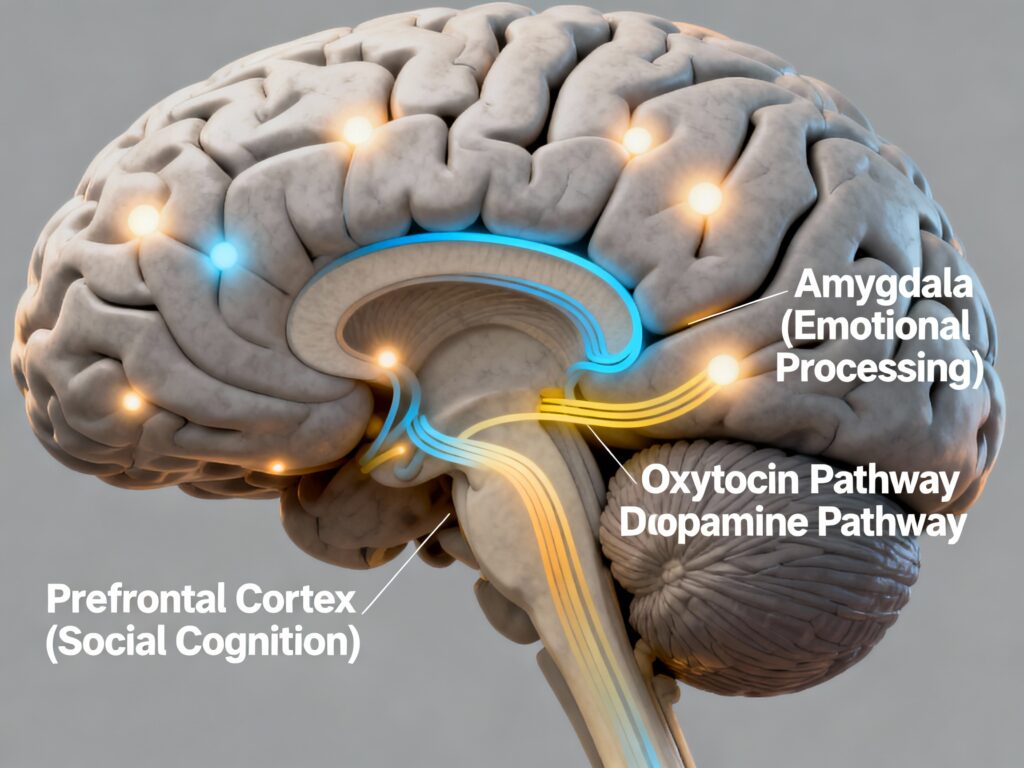
How Eye Contact Hijacks Your Brain’s Reward Centers
When you employ the Triangle Method, you’re not engaging in psychology—you’re engaging in neurobiology. Here’s what happens in the recipient’s brain:
Component 1: Mirror Neurons & Emotional Contagion
What are mirror neurons?
Mirror neurons are brain cells that fire both when YOU perform an action AND when you observe someone else performing that same action. They’re the neural basis of empathy and social resonance.
How they activate during the Triangle Method:
When you gaze at someone’s left eye, their mirror neurons activate simultaneously. Their brain simulates your attention. They feel your interest without you saying anything. This creates what neuroscientists call “emotional contagion”—they literally mirror your level of desire.
Research by Dr. Giacomo Rizzolatti (discoverer of mirror neurons) showed that mirror neuron activation resides in the premotor cortex, inferior parietal lobule, and insula—all directly connected to empathy circuits.
The outcome? The other person feels an inexplicable connection to you. They’re not thinking about it consciously. Their brain is doing the work for you.
Component 2: Oxytocin Spike | The “Bonding Hormone”
Sustained eye contact—especially the dynamic movement of the Triangle Method—triggers a cascade of oxytocin release.
What is oxytocin?
Oxytocin is a neurochemical often called the “love hormone” or “bonding hormone.” It’s responsible for:
- Feelings of trust and safety
- Emotional intimacy and closeness
- Increased empathy and social connection
- Sexual arousal and desire
University of Chicago Study (2020s):
Researchers discovered that when people gaze at someone’s eyes, oxytocin floods the nucleus accumbens (the brain’s pleasure and reward center). The effect is amplified when that gaze is intentional and moves (like the Triangle Method).
One participant reported: “I felt like they were literally looking into my soul. It was uncomfortable but magnetic.”
The Chemical Cocktail:
When you employ the Triangle Method, you create a neurochemical cascade:
- Eye contact → Oxytocin release (trust/bonding)
- Lip gaze → Dopamine anticipation (sexual arousal)
- Eye return → Integrated bonding + desire
This combination is intoxicating to the brain.
Component 3: The “Fight, Flight, or Mate” Filter | Evolution’s Role
Evolution programmed humans to decode eye contact through three primal lenses:
| Eye Pattern | Brain Interpretation | Response |
|---|---|---|
| Fixed, unblinking stare | Threat/dominance | Fear, aggression, amygdala activation |
| Soft, moving gaze | Attraction/bonding | Pleasure, approach, connection |
| Averted gaze | Submission/weakness | Disinterest, disengagement |
The Triangle Method strikes the perfect balance. It’s not threatening (movement breaks aggression signals). It’s not submissive (the gaze is intentional). It’s arousal-inducing attention—exactly what the mating signal should be.
Why the mouth matters:
Evolutionary biologists discovered that looking at someone’s lips subconsciously signals mating interest. The lips are:
- Highly vascularized tissue (changes color during arousal)
- Sensitive to touch (more nerve endings than fingertips)
- Associated with kissing (the pre-mating behavior)
When the Triangle Method includes a gaze at the lips, the brain receives a clear biological signal: “This person is evaluating me as a potential mate.”
Component 4: The University of Chicago Breakthrough | Eyes = Love, Lips = Desire
One landmark study fundamentally changed how researchers understand attraction:
The Study:
Researchers tracked eye movements of participants viewing images of people they felt romantic love for vs. sexual desire for.
The Finding:
| Emotion | Gaze Pattern | Brain Region | Interpretation |
|---|---|---|---|
| Romantic Love | Fixed on eyes | Prefrontal cortex (social cognition) | “I want to know your mind” |
| Sexual Desire | Shifts to mouth/body | Occipital/temporal lobes (sensory) | “I want your body” |
The Genius of the Triangle Method:
By oscillating between eyes (love signal) and lips (desire signal), you create a hybrid attraction response. The recipient’s brain doesn’t know whether to interpret it as romantic love or sexual desire—so it interprets it as both simultaneously.
This is why people report feeling “magnetically attracted” but can’t explain why.
For more on how your brain processes social signals, check out our psychology explained guide.
Top Burning Questions & Myths—FAQ
Is this just manipulation?
Answer: No. Used ethically, the Triangle Method signals genuine interest. It’s manipulation only if you:
- Use it to pursue someone who’s explicitly disinterested
- Continue despite discomfort signals
- Abuse the “plausible deniability” to gaslight someone
Ethical use: Reserve it for moments of genuine chemistry and mutual openness.
Will I look creepy if I do this?
Answer: Only if you:
- Stare for too long (over 5 seconds)
- Look tense or forced
- Have a dead expression
- Use it in the wrong context
Prevention: Warm smile, natural timing, and reading the room eliminate creepiness.
What if they look away?
Answer: Could mean:
- They’re shy or anxious (not rejection)
- They’re uninterested
- They need space
Your move: Don’t force it. Use normal eye contact. If they don’t reciprocate after a few moments, move on respectfully.
Does this work virtually (Zoom, FaceTime)?
Answer: Weaker through video because:
- Eye alignment is imperfect
- Screen distance eliminates pheromone signals
- Pupils less visible
- Oxytocin boost requires direct alignment
Workaround: Still use it, but expect 40-50% reduced effect.
Is there a danger in overusing it?
Answer: Absolutely. Overuse:
- Kills natural chemistry
- Makes you look manipulative
- Receiver detects pattern and feels “hacked”
- Reduces effect through habituation
Rule: Less is more. 2-3 times per conversation, max.
Can neurodivergent people use this?
Answer: Yes, with adaptation. Many neurodivergent individuals find structure helpful. Use the “Inverted Triangle” (eyes + forehead) if direct lip-gazing triggers discomfort.
Real-Life Scenarios: Where the Triangle Method Shines
Scenario 1: First Dates (Coffee Shop)
When to use: During a funny or emotionally charged moment when connection feels natural
How to use:
- You’re laughing at something they said
- They lean in
- You make the Triangle Method movement
- Result: Chemistry intensifies
When NOT to use: While they’re sharing something painful or vulnerable
Scenario 2: Parties/Social Events
When to use: When you sense flirtatious interest from someone across the room or during conversation
How to use:
- You’ve been talking for 5+ minutes
- Connection feels good
- Lean in slightly, employ the Triangle Method
- Result: Sets you apart from every other person making small talk
Scenario 3: Long-Term Relationships (Rekindling Spark)
When to use: During dinner, a moment of intimacy, or while reconnecting
How to use:
- Recreate the intentional attention from early dating
- Slow down and really see your partner
- The Triangle Method during a quiet moment
- Result: Reignites lost chemistry
ETHICAL CONSIDERATIONS: CONSENT & BOUNDARIES
The Responsibility of Knowing This Technique
With knowledge comes responsibility. The Triangle Method works precisely because it activates primal brain systems. This power should never be abused.
Ethical Use:
- Use only when both parties have signaled interest
- Stop immediately if someone seems uncomfortable
- Never use on people in vulnerable positions (drunk, emotionally distressed, at work with power imbalance)
- Remember: Consent is always required
Unethical Use:
- Forcing it on uninterested people
- Using it as a manipulation tool
- Continuing after someone has pulled back
- Using it to bypass consent
The Bottom Line:
The Triangle Method is powerful. Power without ethics is abuse. Use it responsibly.
Quick Tips For Mastery
- Pair with a soft smile – Non-negotiable
- Use only when genuine interest exists – Not a tool for forcing attraction
- Hold each focal point 1-1.5 seconds only – Timing is everything
- Mix with conversation – Don’t make it your only tool
- Calibrate for context – Culture, age, relationship status matter
- Watch body language – If they pull back, stop immediately
- Practice in low-stakes situations first – Build confidence
- Remember less is more – Overdoing kills the magic
TAKEAWAY BOX
The Triangle Method isn’t just a TikTok trend or a “hack” to manipulate attraction.
It’s a neuroscience-backed, evidence-grounded technique rooted in evolutionary biology and validated by peer-reviewed research.
When used ethically, it signals genuine interest through non-verbal communication—activating mirror neurons, releasing oxytocin, and creating authentic connection.
The magic isn’t in tricking someone. The magic is in showing someone they’re worth your complete, undivided attention.
Use it wisely. Calibrate for chemistry. Watch attraction unfold naturally.
FREQUENTLY ASKED QUESTIONS
Q1: Can I teach the Triangle Method to someone else?
A: Yes. Share this article. The technique is more effective when both people understand the psychology behind it—it removes the “manipulation” concern and builds mutual understanding.
Q2: What if I naturally use the Triangle Method without knowing?
A: You might already be doing it intuitively. Many naturally charismatic people unconsciously employ similar patterns. This guide simply makes it deliberate and effective.
Q3: Does the Triangle Method work in texting or messaging?
A: No. It requires real-time eye contact and facial expressions. Virtual versions are weakened significantly.
Q4: Is there a professional version for business contexts?
A: Yes. Use the “Professional Triangle”: left eye → forehead/brows → right eye. Builds rapport without sexual undertones.
Q5: How quickly will I see results?
A: Immediate. If executed correctly during a moment of mutual interest, you should notice: increased mirror behavior, leaning in, dilated pupils, softened expression within 30 seconds.
CONCLUSION: YOUR PATH TO MASTERY
The Triangle Method represents a convergence of evolutionary biology, neuroscience, and social psychology.
Understanding it gives you a powerful tool. Using it ethically makes you irresistible.
Whether you’re looking to accelerate attraction on a first date, reignite connection in a long-term relationship, or simply build deeper rapport with someone you genuinely like—this technique works.
But remember: the power is in authenticity. The Triangle Method doesn’t create attraction from nothing. It amplifies existing chemistry and signals genuine interest in a way that bypasses verbal communication.
Master the timing. Perfect the smile. Read the room. Respect boundaries.
The rest will follow naturally.
Ready to take your dating and social skills to the next level? Master the Triangle Method, and watch how people respond to your genuine, intentional presence.
Want to improve further? Explore our guides on dating psychology tips and first date conversation starters to master all aspects of modern dating.